
Great delivery teams are designed at the joins
With our seventh Prime Minister this decade, another wave of Cabinet reshuffling, and departmental comings and goings, it might be a surprise that we’ve focused this insight on a report based on a year-old dataset and a set of projects which has been subsequently consolidated.
Delivery stories, especially macro trends, often go missing when the political stories are the noisiest.
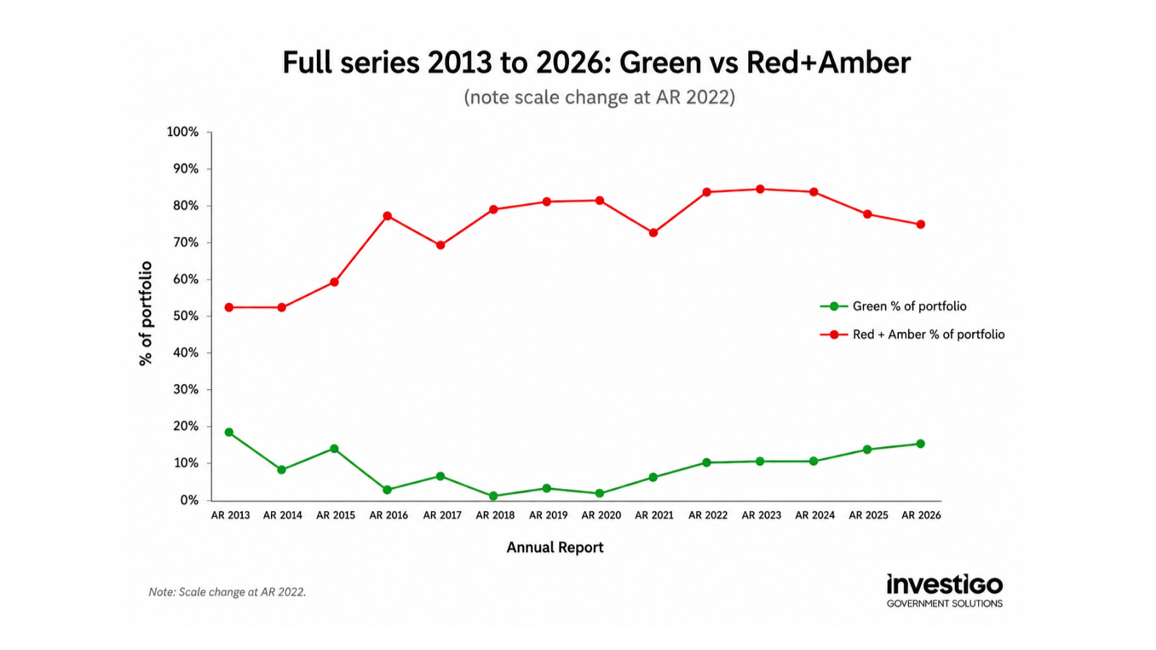
On 13 July, NISTA published its Major Projects Annual Report: 189 programmes carrying nearly a trillion pounds of whole-life cost, of which 29 were rated Green, 109 Amber and 34 Red. It is worth noting the report describes the portfolio as it stood between April 2025 and March 2026, before NISTA reset the GMPP to around 81 projects in April.
Regardless, this analysis is not based on a snapshot, but a longer-term view. Across fourteen annual reports going back to 2013, through two rebrands of the body doing the assessing, the share of the government's most significant programmes assessed as highly likely to succeed has never once reached one in five.
There is an undoubted upward trend in the last five years of Green status (and then often an exit at Green, as NISTA’s commentary explains.) But regardless, this 20% figure struggles to be surpassed.
Some might argue that this is ‘about right’ – the programmes in scope of these reports are the hardest and most important that government embarks upon. Similarly, the Red trend has been of a slow decline as Green has risen. So is there anything really to talk about here?
It’s worth asking what that positive Green trend means
Five years of hard effort has taken the Green share from about one in ten to one in six; undoubtedly real movement.
It has however come from levers that are, by now, well worn. Assurance, gateway reviews, spending controls: a decade of refinement has caused a steady, slow incline. That is roughly what you'd expect a maturing set of tools to do, but it is not evidence that the same tools, pushed harder, will lead to transformational change.
We are focused on an under appreciated lens - the joins between the people doing the work.
We focus on who gets to decide, who carries the thread when leadership turns over, and whether the team is shaped around the system or around the org chart. Government has spent real effort on the capability of its people. It has spent far less on how those people are wired together, and that is where the hardest programmes tend to come apart.
The argument you hear most often is about the mix of the team.
External spend grew quickly over the last decade, and institutional knowledge often walks out of the door when a contract ends.
There is a legitimate instinct that the state ought to be capable of doing a lot of this work itself, and this argument is made coherently across government contracts, with true upskilling expected across the board.
But the blended profile of the team has never truly been the thing that turns a programme’s success. Green programmes use consultants. Red programmes have career civil servants. And the reverse, just as often.
What separates them, in our experience, is the seams: the joins between people, organisations and decisions, where authority, accountability and technical architecture meet, and where nobody has usually been asked to do any design at all.
Decision rights. The question that matters is who can say no. On blended programmes the missing capability is almost never the capacity to build something, it is the authority to stop something that should not be built. In practice, decision rights tend to default to whoever happens to be the most senior person in the room that day.
Accountability continuity. Government's own guidance says a Senior Responsible Owner should serve for the life of the project, and practice has historically run some way short of that. The APM's commentary places leadership change, shifting accountabilities and loss of organisational memory among the most common sources of delay and cost overrun. What gets lost in a handover is rarely the plan, but rather the discussion behind it, and above all why the discounted options were rejected.
Architecture. Delivery teams are built around the organisation chart, the funding lines, and the departmental boundaries, rather than around the system being delivered. The system then ends up mirroring the shape of the organisation that built it, whether or not that shape makes any sense for the service. Workstream boundaries do not correspond to service or data boundaries, and integration can be owned by nobody, because integration belongs to the gaps, and governance prefers components.
The pattern across all three is the same. Difficulty shows up at the joins rather than in the parts, and every part passes its own assurance on the way there. That is how a portfolio of individually well-run projects never reaches one in five.
So what?
The lever government has reached for is external spend restriction. Some of that spend did not buy value, and departments have repeatedly bought capacity when what they needed was capability, so the instinct behind the cuts is sound.
However, the NAO found that government does not hold consistent data on what it spends on consultants at all, with estimates ranging by the billions.
The deeper issue is that the lever is aimed at the mix rather than the seams. Remove every consultant tomorrow and decision rights are still undefined, SROs still rotate, and the programme architecture still mirrors the org chart.
None of this is a credible argument against external support. The NAO's own survey found that 86% of respondents thought consultants added value, most clearly when solving specific problems requiring expertise the civil service does not hold.
Ours is an argument about how those teams get designed.
The three steps to fix this problem, and the warning signs for a programme:
Decision rights should be defined before mobilisation, not discovered by who is the canniest operator in flight. The warning sign is a RACI drafted once, filed, and quietly ignored by month three because it no longer describes how anything actually works.
Capability transfer is written into the contract rather than appended to it. The warning sign is knowledge transfer scheduled as a closing phase, which makes it the first thing cut when the budget tightens or when deadlines slip.
Team architecture and technical architecture are designed together. The warning sign is solution architects and delivery leads meeting for the first time after mobilisation, by which point both structures are fixed.
Takeaway:
The point is not that anyone is particularly bad at this, or at fault. These are the hardest and most novel things the state does, and the reports say so themselves: a Red rating does not mean a programme will fail. Many of government's greatest successes have been Red along the way.
The point is that the difficulty has stayed in exactly the same place for a decade, through every change in who is in charge and in how the portfolio is counted. That is what a structural problem looks like rather than a performance one.
You cannot cut your way to delivery confidence. You cannot hire your way there either. You must design it differently.